Thursday, August 6, 2009

Italy


ITALY
My second trip to Italy and I have to say that I appreciated the art and culture even more
this time around.


Lake Como was our first adventure. Certainly the homes of the rich and famous that dot this glacial lake are most impressive but the views of the mountainous steps to the Alps are awe inspiring. It was a cool morning but once on the lake the chill retreated as the clouds gave way to the sun.


An hour bus ride and we were back at our hotel. We were not to happy to find out our luggage had still not yet arrived and the clothes we were wearing were becoming a bit ripe. Fortunately the smell of garlic and parmesan cheese helped us to fit in at dinner. The food was exceptional and with all the wine you can drink the opera singer sound pretty good by the end of the night.


Given today's architecture with building of glass and metal one does have to wounder, how have we lost our way? With primitive equipment and unlimited imaginations the stone masons created some the worlds preeminent churches. Structures that today are centuries old and will likely last for a thousand years.


Florence: Basilica di Santa Maria del Fiore is the church, Duomo, begun in 1296 completed structurally in 1436. If you don't have an appreciation for history then don't travel to Italy.


No matter where you visit in Italy there are churches that baffle the imagination.


This bridge, Ponte Vecchio, turned indoor market really captured my imagination. I think it was from a story I had to read in grammar school. It was some place deep in my subconscious.


Ponte Vecchio, the oldest of Florence's six bridges, is one of the city's best known images. Probably going back to Roman times with its stone pillars and wooden planks; it was built in stone but then newly destroyed by a flood in 1333. It was built again twelve years later.
The five arches became three and the main part was widened. The shops, housed under the porticos, first belonged to the Commune which then rented them out. But later on, towards the 15th century, they were sold to private owners and began to change through subsequent additions, raised parts and external terraces, extending towards the river and altering the original architecture in an anarchical, suggestive way.

This shopping center is new Florence with the rich and want to be famous strolling through the upscale stores. Watch out for crooks and pick pockets! Both in the stores and in the massive corridor.


UNDER CONSTRUCTION!! CHECK OUT PAST POSTS.

Thursday, June 12, 2008

High on Atlanta's High Museum

High Museum, Atlanta Georgia... Louvre and the Ancient World


OK! So you are not in to museums. I understand but this is also history with masterpieces from the beginning of our civilization. The museum itself is a unique structure and worth seeing even with out the art. So pass up the
contemporary paintings of white canvas with vertical lines ( who made the decision that this is art?) and head directly to the "Louvre and the Ancient World" exhibit.

As described by the High:
"The Louvre and the Ancient World features masterpieces from the founding cultures of Western civilization, including more than 70 works from the Louvre's unparalleled Egyptian, Near Eastern and Greco-Roman antiquities collections. Showcasing works dating from the third millennium BC through the third century AD, the exhibition examines the rise of the museum and its collections of antiquities under Napoleon, the discoveries and decipherment of hieroglyphics and cuneiform and the Louvre's leading role in excavating the cradle of civilization at the end of the nineteenth century and during the 20th century (most of the excavations for Near East).
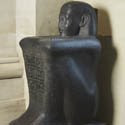
The oldest works in the exhibition are drawn from the ancient cultures of Egypt, Susa (in modern Iran), the Neo-Sumerian city of Tello (in modern Iraq) and the Canaanite city of Ugarit (in modern Syria). Key works from these periods include the diorite Statue of Wahibre, Governor of Upper Egypt (Late period Egyptian); an Egyptian papyrus that belonged to the first Egyptian Museum whose curator, Jean-François Champollion, is credited with first deciphering hieroglyphics (Third Intermediate Period); an Attic black-figure amphora attributed to the potter Exekias (550–540 BC); and a dolerite Statue of Gudea, Prince of Lagash from Tello (Neo-Sumerian Period).
A special installation showcases the colossal, ten-foot-long Tiber—one of the largest sculptures in the Louvre's collections. The statue, discovered in 1512, decorated a sanctuary dedicated to Isis and Sarapis and was the pendant to a similar statue depicting the Nile, which is currently in the Vatican collection in Rome. The work explores the river's link to Roman mythology and its fertility. It depicts a river god accompanied by both Romulus and Remus, the city's legendary twin founders, while the reliefs on its base illustrate another myth about the founding of Rome and the river's beneficial effects."

Don't miss the remarkably well preserved clay tablets. I wonder if our CD's will last 3000 years? The exhibit is in Atlanta until September.
http://www.high.org/main.taf?p=3,1,1,1,1.